EUV – Soft X-rays, Wavelength-Tuned for Discovery
Tune the wavelength. Discover what’s next.
Published in Communications Physics, a Nature Portfolio journal
 |
| Tuneable EUV – Soft X-rays |
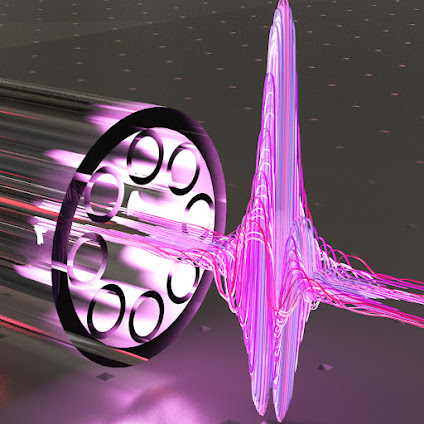
A different wavelength can reveal a different story. A new tabletop technique gives researchers the freedom to explore those stories with bright, laser-like extreme-ultraviolet and soft-X-ray light whose wavelengths can be tuned continuously. Developed by researchers at TU Wien, the University of California San Diego and Few-Cycle Inc., it combines adjustable wavelengths with high brightness and sharply defined spectral lines.
The technique relies on high-order harmonic generation, or HHG, which turns intense laser pulses into much shorter-wavelength light. Usually, this produces a series of separate spectral peaks. Between them are gaps – and an experiment’s most useful wavelength may land in one. By carefully shaping the driving laser pulses through interactions with gases and a crystal, the team makes those peaks move smoothly across the gaps without blurring them together.
The colour of the driving laser also matters for brightness: shorter-wavelength pulses can boost the yield of high harmonics, as demonstrated in earlier work using ultraviolet lasers [2]. The new technique builds on this principle while adding continuous wavelength control.
This combination of brightness and wavelength control could help researchers explore the magnetic world hidden inside everyday materials. In tiny structures containing iron, cobalt and nickel, different wavelengths could be used to pick out each element’s magnetic response. Researchers could investigate how those components behave individually and how they change together.
 |
| From IR Tunability through VIS to EUV–Soft-X-ray Tunability |
The possibilities reach into nuclear-clock research, too. At suitable wavelengths, the approach could be used to search for and map energy transitions in nuclear-clock candidates. These transitions could supply the reference “tick” for future precision timekeepers – connecting adjustable light with new ways to measure time.
There is another dimension to explore: speed. The light is predicted to form trains of bursts lasting less than 300 attoseconds each, opening opportunities to investigate extraordinarily fast changes in matter. Wavelength control could help determine what comes into view; ultrashort bursts could help reveal how it changes.
For more information, please visit Ref [1].
Cite as:
[1] D. Popmintchev, et al. Narrowband and wavelength-tuneable bright EUV–soft-X-ray harmonics for resonant imaging and spectroscopy. Communications Physics (2026). DOI: https://doi.org/10.1038/s42005-026-02791-5
[2] D. Popmintchev et al. Ultraviolet surprise: Efficient soft x-ray high-harmonic generation in multiply ionized plasmas. Science 350, 1225–1231 (2015). DOI: 10.1126/science.aac9755

Comments
Post a Comment